Bridging arXiv astrophysics and backyard stargazing

Read Nature and arXiv without the physics PhD.

AstroReader decodes dense astrophysics papers — tensor equations, spectral signatures, cosmological jargon — into a summary tuned to exactly how deep you want to go.

Free plan, no credit card. The Weekly Recap is public — no account needed.

Interactive sandbox

One paper. Three depths.

Switch the comprehension tab — the translation updates in real time.

◆ Loading a real example…
Raw source · academic feed
Loading…
Loading…
AstroReader translation layer
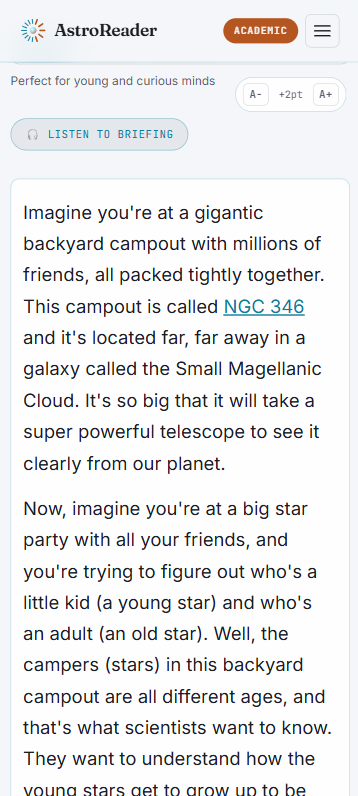
Explain it like I'm 10
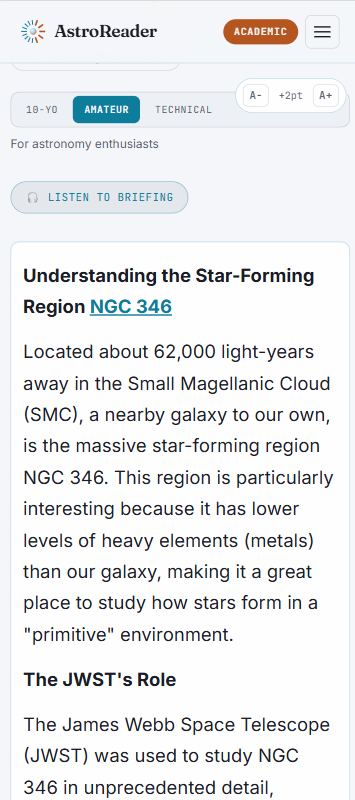
Amateur astronomer
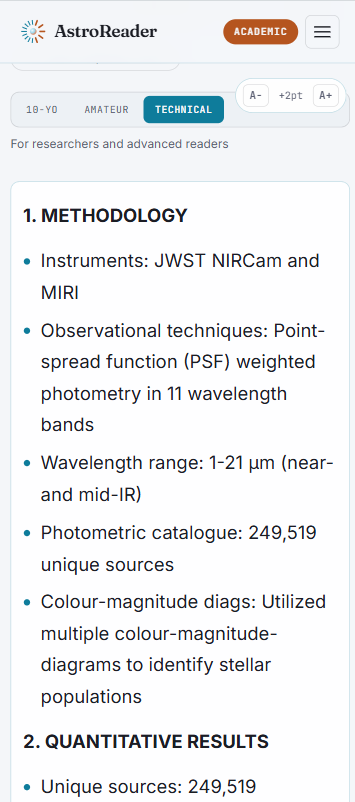
Technical data
Inside the workspace

Nine ways to keep up with the sky

Free · No account

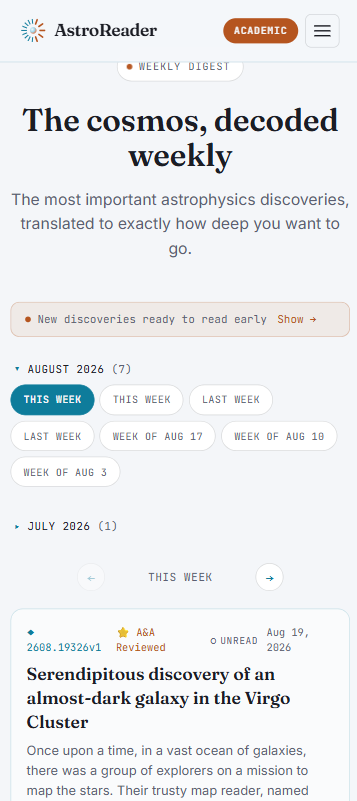
Weekly Recap

Every week, one plain-language paragraph per arXiv category on what the field actually found — not a list of titles, the findings themselves.

Read this week →
Free · No account

Tonight's Sky

The digest is weekly; the sky is nightly. See what's actually visible from where you are tonight — moon phase, darkness window, and the objects worth going outside for — each linked to the papers written about it.

See tonight's sky →
Free · No account

Sky Objects

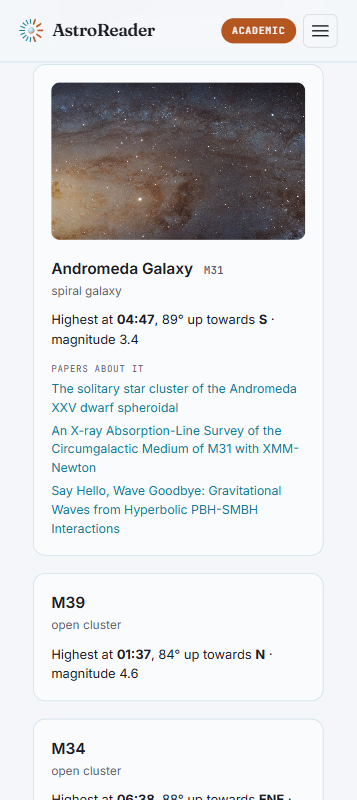
A proper page for every catalogued object with an image or a paper written about it — an archive photo, when it's visible from where you are, and the arXiv research that studied it. "What is NGC 1300" gets an answer, not just a Wikipedia stub.

Browse sky objects →
Free plan

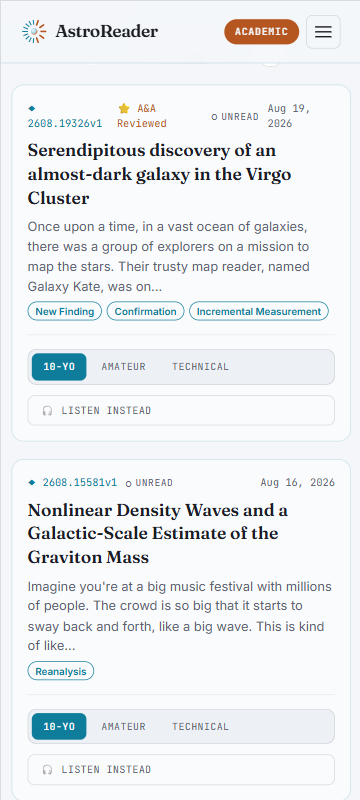
Weekly Digest

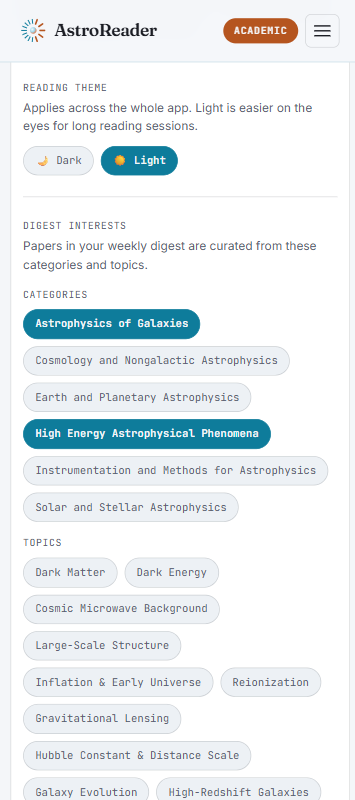
The most important astrophysics discoveries of the week, translated at your depth and delivered to your feed. Free account included, 3 issues a month — you choose how the email is written, and every paper can be favourited, rated and tracked as read.

Free plan

Follow a Telescope

Every paper already carries the facility it credits. Follow JWST, Hubble, ALMA or any of the others and their papers land in one feed as they publish — plus an optional weekly email, one message a week however many you follow, never one per paper.

Pro plan

Cosmic Briefings

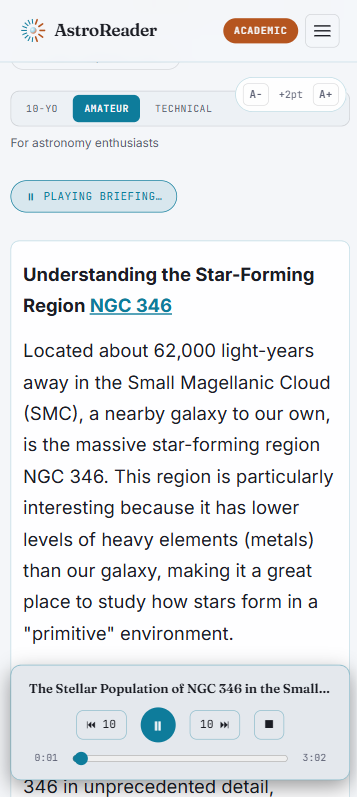
3–5 minute audio versions of translated papers — science for your commute.

Pro plan

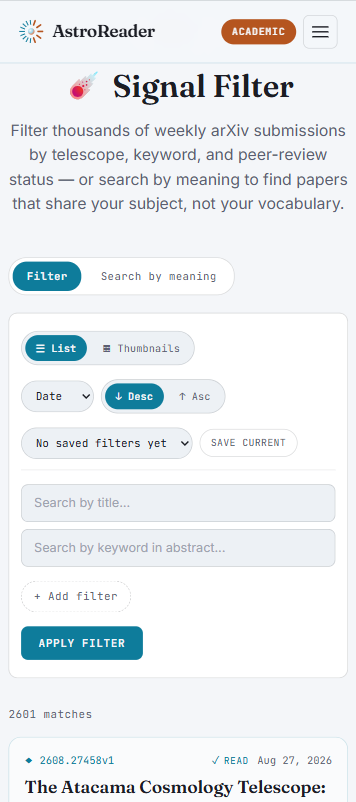
Signal Filter

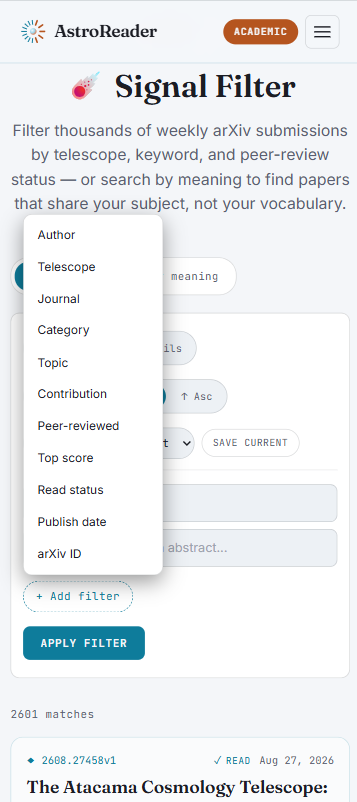
Filters thousands of weekly arXiv papers by telescope, subject, keyword and peer-review status — plus search by meaning, and a related-papers panel on every article that shows why each match surfaced.

Academic plan

Research Workspace

Pull the exact figures out of up to 10 papers at once, compare them in one table, and import your ADS library or .bib file.

How it works →
Free · No account

Nebula Glossary

Tap any dense term while reading to get a plain-language analogy, instantly.

Browse the glossary →
Questions

Frequently asked

What is AstroReader?
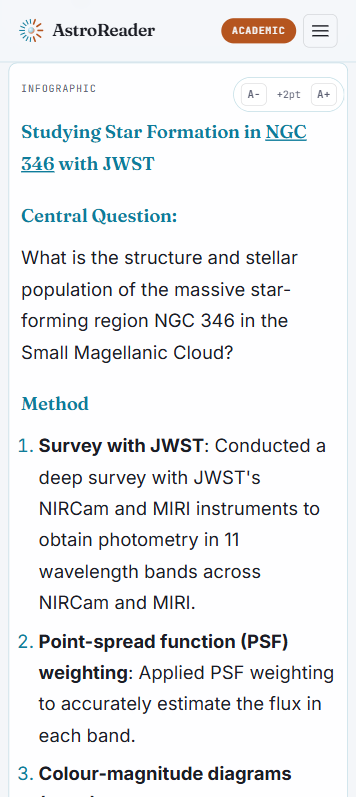
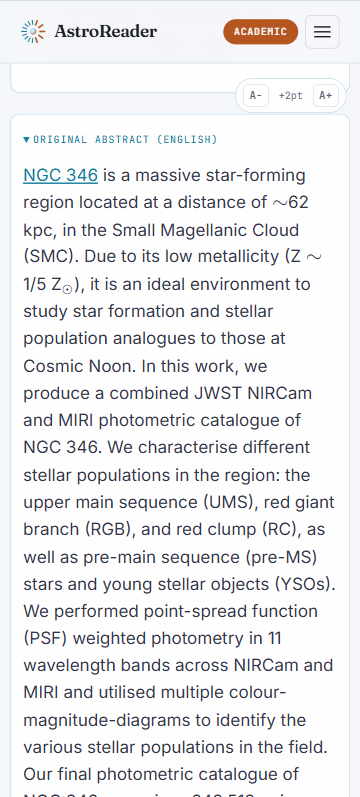
An intelligent reading layer that translates dense astrophysics papers from arXiv and Nature into three depths — a plain-language explainer, an amateur-astronomer breakdown, or the full technical summary — so you choose exactly how deep to go.
Who is AstroReader for?
Anyone curious about space who doesn't have (or want) a physics PhD to get there — casual space fans, telescope owners and astrophotographers, physics students, and researchers doing lit reviews. The three depth levels exist so the same paper works for all of them: 10-YO for a plain-language explainer, Amateur for astronomy-literate detail, or Technical for the full data.
Can parents use it to tell space stories to their kids?
The "10-YO" depth is written in plain language with real-world analogies, so it's easy to read aloud to a curious kid. That said, it's a translated science summary rather than a bedtime-story generator, and AstroReader isn't designed or moderated specifically for children's use.
How does the 3-depth translation work?
Every paper is translated at three levels: "10-YO" explains it with real-world analogies, "Amateur" keeps the astronomy vocabulary but skips the heavy math, and "Technical" preserves the full data and jargon. Switch between them anytime — the raw source is always one tap away.
Which sources does AstroReader pull from?
The arXiv astronomy feed and Springer Nature Open today, cross-referenced with the NASA ADS engine for citations.
What's the difference between Free, Pro Hobbyist, and Academic?
Free gives you the Weekly Recap, Tonight's Sky, public Sky Object pages, 3 Weekly Digest issues a month at 10-YO depth, unlimited telescope follows with the weekly follow email, the Nebula Glossary, and the whole reading shelf — favourites, 1–5 star ratings, automatic read tracking with a read/unread filter, saved filter presets with a default view, and control over how your digest email is written. Pro Hobbyist ($9/mo) unlocks unlimited digests across all three depths, unlimited Cosmic Briefings audio, and Signal Filter. Academic ($19/mo) adds the Research Workspace — structured data extraction, cross-paper comparison tables, and ADS/.bib import — on top of everything in Pro. Observing features like Tonight's Sky, the Sky Objects catalog, following a telescope and the Nebula Glossary stay free on every plan — they're never paywalled. See the Pricing page for full details.
Do I need a credit card to start?
No. The Weekly Recap, Tonight's Sky, the Sky Objects catalog and the Nebula Glossary are all public and need no account at all, and the Free plan needs no card. Pro and Academic are paid through Stripe checkout, and you can cancel anytime.
What is the Weekly Recap?
A free, public page summarising the week across astrophysics — one plain-language paragraph per arXiv category on what was actually measured, observed or ruled out, written from that category's strongest papers and linking back to every one of them. Each week gets its own permanent link, so you can share or revisit it. Read this week's →
What is Tonight's Sky?
A free, public page showing what's actually visible from your location tonight — moon phase, when it gets dark, and the catalogued objects worth going outside for, ranked by how good a target each one is rather than listed in catalog order. Every object links to the arXiv papers written about it. Works from a city pick or your browser's own location, kept only to the nearest tenth of a degree, and no account is required. See tonight's sky →
What are Sky Objects?
A public, permanent page for every Messier and NGC catalog object worth one — an archive image, when it's visible from your location, and the arXiv papers actually written about it. It's the answer to "what is NGC 1300" that a search engine hasn't had until now: no account needed, and every object either has an image or a linked paper before it gets a page at all, so it's never a wall of empty catalog entries. Browse sky objects →
What is Follow a Telescope?
A feed for the facilities you actually care about. Every paper is already tagged with the telescope or observatory it credits, so following JWST, Hubble or ALMA turns that tag into a personal feed — papers from everything you follow, merged and newest first. Turn on the optional weekly email and you'll hear about it once a week, grouped by facility, titles and links only — never one message per paper. Free on every plan; needs an account. See what you can follow →
What do the nine modules do?
Weekly Recap gives you the whole week in one paragraph per category, free and public. Tonight's Sky shows what's visible from your location tonight, also free and public. Sky Objects is a permanent public page per catalogued object, image and papers included. Weekly Digest curates the week's biggest discoveries at your chosen depth. Follow a Telescope turns the facilities you care about into a feed and a weekly email. Cosmic Briefings turns translations into 3–5 minute audio. Signal Filter narrows the arXiv feed by telescope/keyword/peer-review status. Research Workspace (Academic) extracts exact figures from 2–10 papers into one comparison table. Nebula Glossary gives you a plain-language analogy for any dense term, free and public. See Resources for the full breakdown.
Can I still read the original paper, not just the translation?
Yes. AstroReader is a layer on top of the paper, not a replacement for it — the raw source is always linked alongside every translation.
Is AstroReader live yet?
Yes — AstroReader is live in public beta and open to everyone. All nine modules are running; sign up free from the nav above, or use the public Weekly Recap, Tonight's Sky, Sky Objects and Nebula Glossary without an account.
Resources

What's running inside AstroReader

Nine modules, each solving a different part of the "I want to keep up with space but don't have time" problem.

RECAP

Weekly Recap

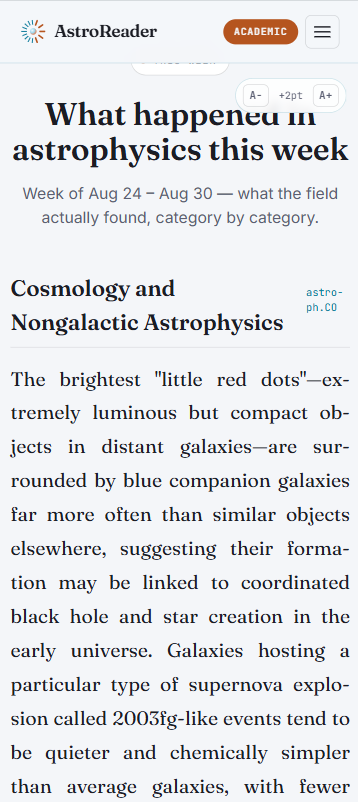
The whole week of astrophysics, one paragraph per arXiv category. Instead of handing you a list of titles to triage, each category gets a short piece of prose about what was actually measured, observed or ruled out that week — written from the strongest papers in that category and linking back to every one of them, so the claims stay checkable. It's public: no account, no plan, permanently linkable week by week.

Cadence: weeklyCoverage: per arXiv categoryFree · no account
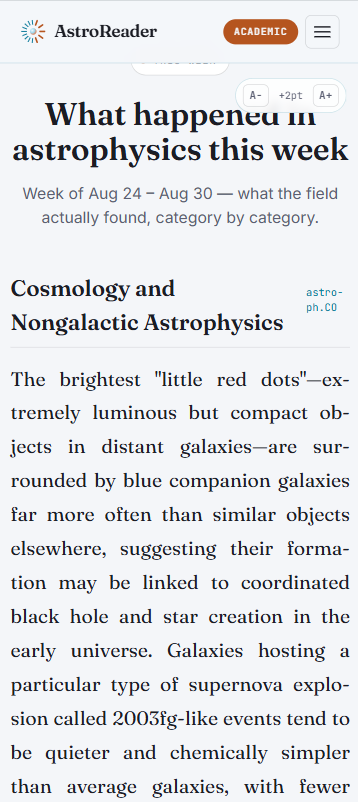
Weekly Recap page showing 'What happened in astrophysics this week' with a per-category summary.
Read this week's recap →
TONIGHT

Tonight's Sky

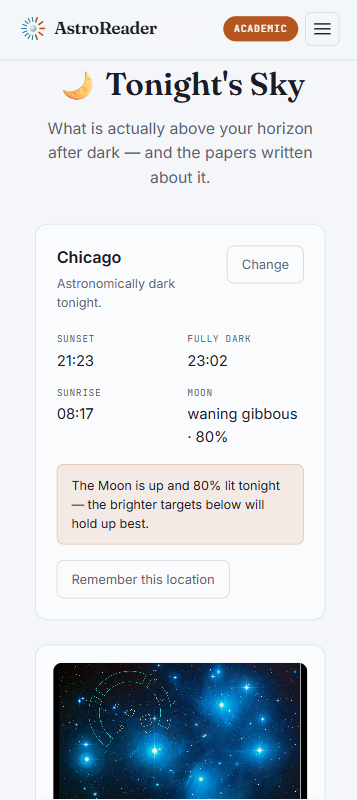
The rest of the app runs on a weekly clock; the sky doesn't. Tell it where you are — a city, or your browser's own location, kept only to the nearest tenth of a degree — and it works out what's actually above your horizon tonight: moon phase and illumination, when it gets properly dark, and the catalogued objects that clear a usable altitude before sunrise, ranked by how good a target each one actually is rather than listed in catalog order. Every object carries its archive image and the arXiv papers written about it, so a bright night out is also a way into the research. No account needed, and it never will be — observing what's visible tonight isn't a paid feature.

Cadence: nightlyLocation kept to 0.1°Free · no account
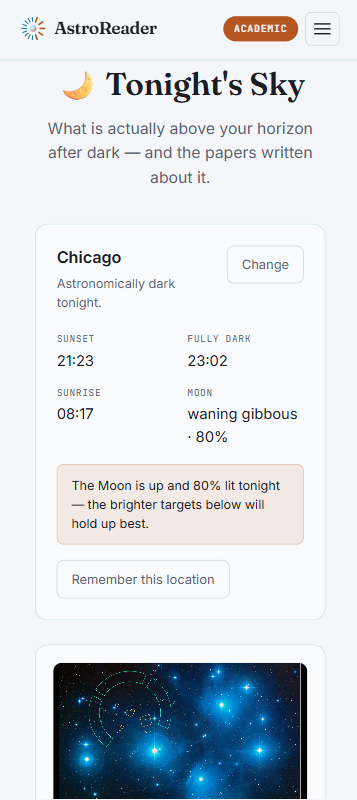
Tonight's Sky screen showing sunset/dark/sunrise times and moon phase for Chicago.
See tonight's sky →
OBJECTS

Sky Objects

Every Messier and NGC object gets a proper page: its archive image, when it's visible from your location, and the arXiv papers actually written about it — the bridge from "I looked this up" back into the research. "What is NGC 1300" is a search with steady volume and no good answer today, and this is built to be one: permanently linkable, no login, no plan. It's also deliberately not the whole ~13,000-object catalog turned into pages — an object only gets one once it has an image or a linked paper, so search results point at something worth finding rather than an empty stub.

Cadence: as curatedCoverage: Messier + NGCFree · no account
Browse sky objects →
DIGEST

The Weekly Digest

A curated publication delivering the most important astrophysics discoveries of the week straight to your feed. It skips the news-portal noise and links directly to peer-reviewed source data, packaged in our multi-depth format so you choose how far to go on each story.

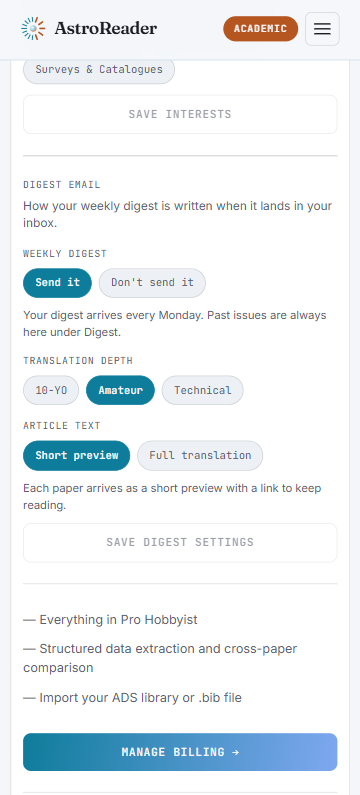
Every account also controls how the email itself arrives: which of the three translation depths it carries (Free plans get "10-YO"), and whether each paper comes as a short preview with a link to keep reading or the full translation inline. Papers you open are marked as read automatically, and you can favourite or rate any of them from the article page.

Cadence: weeklySources: arXiv, NatureFree tier: 3 issues/moFree: favourites, ratings, read tracking
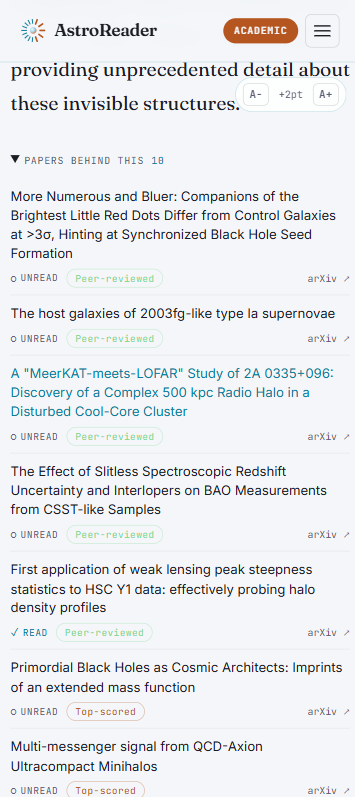
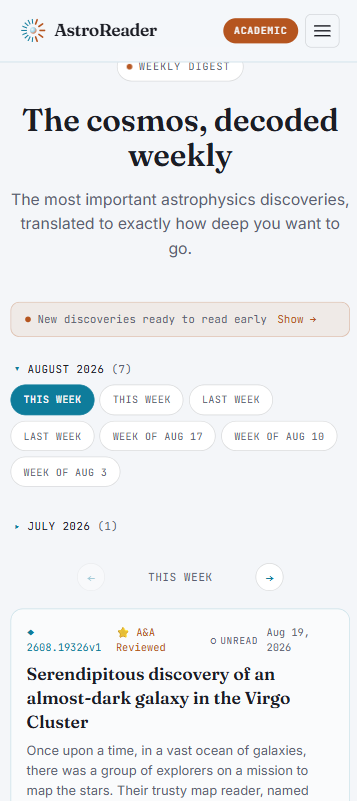
AstroReader Weekly Digest dashboard listing recent weeks of issues.
FOLLOW

Follow a Telescope

Every paper is already tagged with the facilities it credits, at the moment it's ingested — JWST, Hubble, ALMA and every other observatory this catalog knows. Following one turns that tag into a feed: every paper it's credited on, merged across everything you follow and newest first. It's the cheapest way to make an account feel like yours — people have favourite telescopes the way they have favourite teams.

Turn on the optional weekly email and you'll hear about it once a week, grouped by facility, titles and links only — never one message per paper, however many you follow or however busy the week was.

Cadence: as published, weekly email optionalUnlimited followsFree plan
AUDIO

Cosmic Briefings

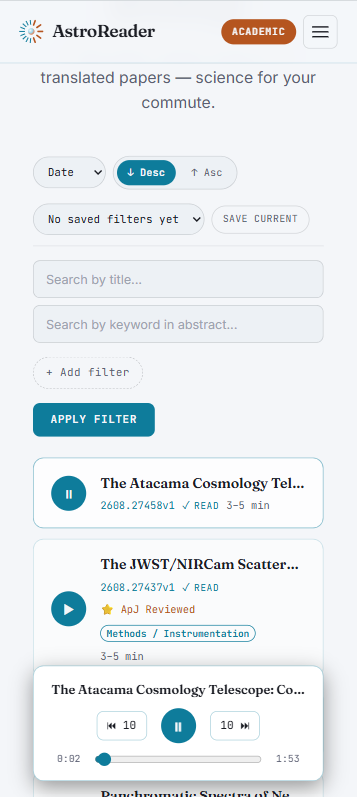
A high-fidelity text-to-speech system that turns translated papers into 3–5 minute podcast-style briefings. Built for listening during a commute instead of losing an evening to a PDF.

Format: audioLength: 3–5 minPro tier: unlimited
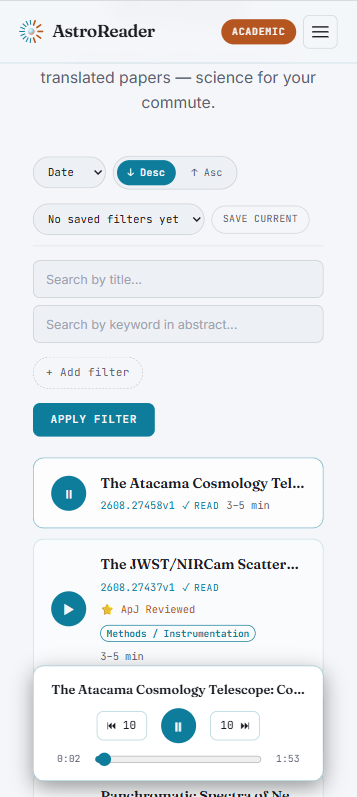
Cosmic Briefings list of audio briefings with play controls and waveform.
FILTER

Signal Filter

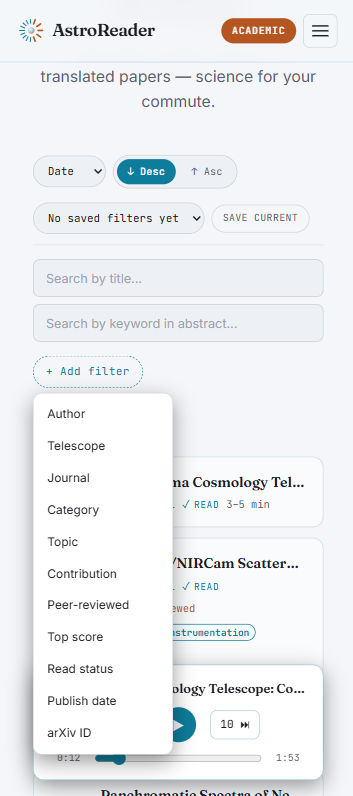
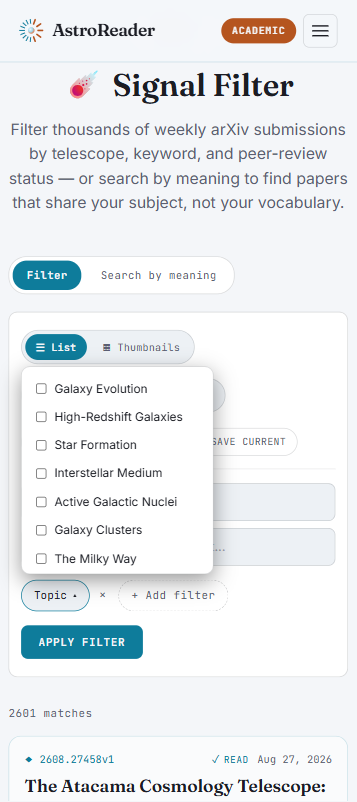
A server-side filter that scans thousands of weekly arXiv submissions for specific telescope identifiers (JWST, Hubble, ALMA…) and peer-review metadata, surfacing only the highest-confidence, most relevant research.

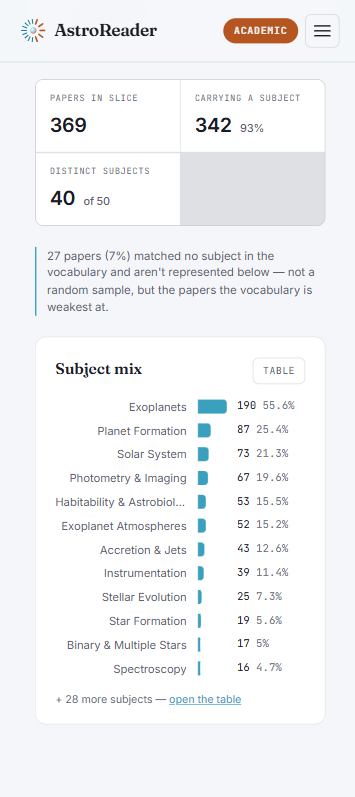
It also filters by subject — a controlled vocabulary of 50 astronomy topics, one level finer than arXiv's own categories, which lump 30–50 papers a day into each. "Tidal disruption events" is a subject; astro-ph.HE is a mailing list.

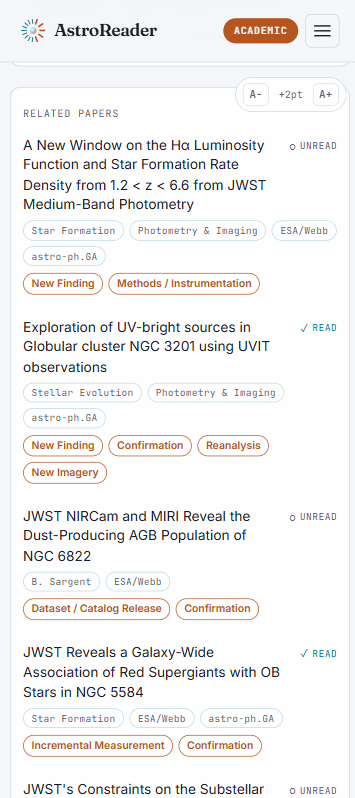
And from any paper, a related papers panel shows the work that shares its authors, instruments or subject — ranked, with the reason for each match shown, so you can see why a paper surfaced. A team's follow-up on an adjacent topic still counts as related, which is exactly the paper a text-similarity search would miss.

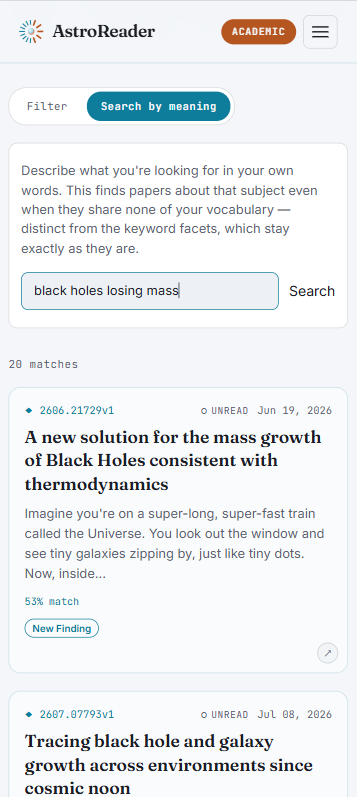
Search by meaning sits alongside the keyword facets rather than replacing them. Describe what you're looking for in your own words and it finds the papers that are about that — even when they share none of your vocabulary. The two answer different questions: keywords find the word, this finds the subject.

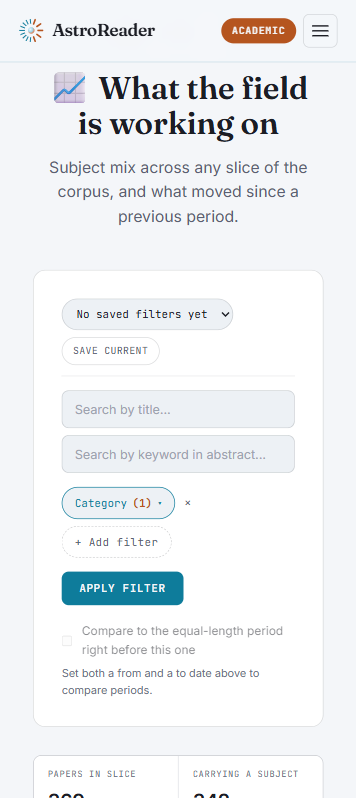
Any filter combination can be saved under a name, reloaded later, renamed or deleted — and one of them set as the default that loads every time you open the page. Saved presets and the read/unread filter are free on every plan.

Sources: arXiv categoriesFilters: telescope, subject, keyword, review status, read/unread50 subject topicsSemantic + keyword searchFree: saved presets
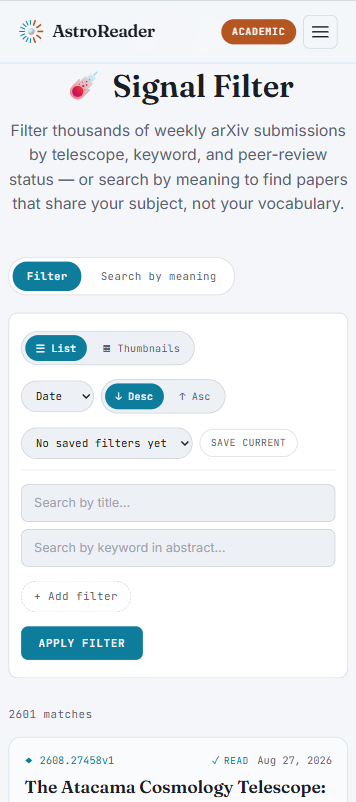
Signal Filter screen showing filter controls and a list of matching papers.
RESEARCH

Research Workspace

The Academic tier's own module, built for lit reviews rather than reading one paper at a time. Pick 2–10 papers, name up to 8 metrics you care about, and get the extracted figures back in a single comparison table — with an explicit flag when a paper simply doesn't report the number you asked for, instead of a plausible-looking blank. Sessions save as you work, and you can seed one straight from an imported ADS library or .bib file.

2–10 papers per comparisonUp to 8 metrics.bib / ADS importAcademic tier
See the Academic plan →
GLOSSARY

Nebula Glossary

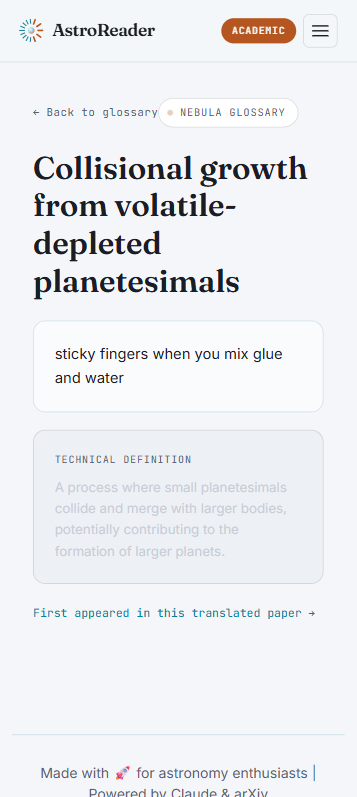
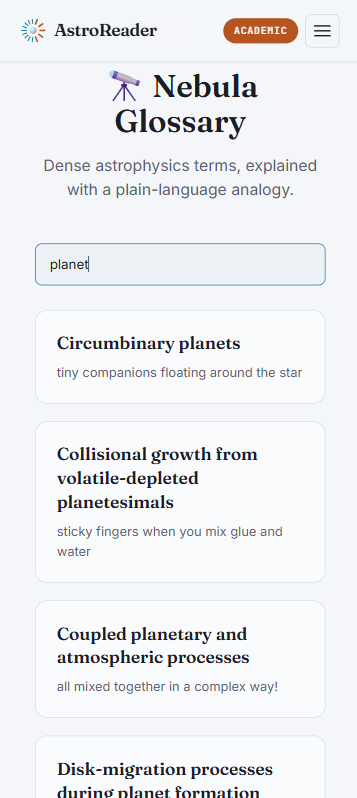
An on-the-fly dictionary layer built into the reader. Tap or hover any dense physics term and get a real-world analogy — no need to leave the page or lose your place.

Trigger: tap / hoverFree · no account
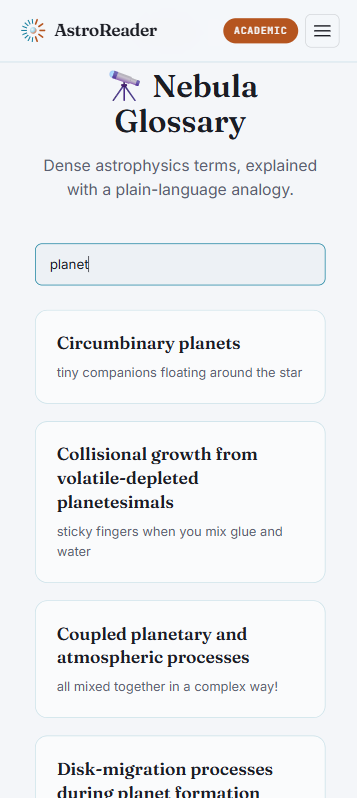
Nebula Glossary search screen listing dense astrophysics terms with plain-language taglines.
Browse the glossary →
Pricing

Pick your reading depth

Start free. Upgrade when the weekly digest isn't enough.

Casual Explorer

Free

For casual space fans who want simple weekly insights.
$0/ forever
  • Weekly Recap — full access, every week
  • Tonight's Sky — free forever, on every plan
  • Sky Objects — every catalogued object's page, free forever
  • Weekly Digest — 3 issues / month, "10-YO" depth only
  • Digest email settings — pick your depth and full-text or preview
  • Follow a Telescope — unlimited follows, optional weekly email
  • Favourites and 1–5 star ratings on every paper you read
  • Read tracking — filter for what you've read or haven't
  • Saved filter presets, with one set as your default view
  • Standard arXiv category routing
  • Web dashboard access
  • Nebula Glossary — free forever, no account needed
Start reading
Most popular
Backyard Astronomer

Pro Hobbyist

For telescope owners, astrophotographers and deep-space hobbyists.
$9/ month
  • Everything on the Free plan
  • Weekly Digest — unlimited issues, all three depths
  • Unlimited arXiv + open-access papers
  • Unlimited Cosmic Briefings (audio)
  • Signal Filter — telescope, subject topic, keyword and peer-review facets
  • Related papers on any article, showing why each one matched
  • Search by meaning — find papers on your subject that use none of your words
Go Pro
Research Analyst

Academic

For lit reviews and thesis work — built for comparing papers, not just reading one at a time.
$19/ month
  • Everything in Pro Hobbyist
  • Research Workspace — compare 2–10 papers on up to 8 metrics at once
  • Structured data extraction — exact figures, not just prose summaries
  • Flags when a paper doesn't report the number you need
  • Saved research sessions that autosave as you work
  • Import your ADS library or .bib file to get started
Go Academic

Start free, upgrade whenever · Secure checkout via Stripe · Cancel anytime

About us

Why AstroReader exists

Science communication is broken

Every week, real breakthroughs about exoplanets, dark matter and deep-space structure get published on arXiv or locked behind prestigious paywalls like Nature. Unless you have a graduate degree in tensor mathematics or quantum mechanics, reading the actual source is close to impossible.

Mainstream science news tries to close that gap, but it usually arrives days late, leans on clickbait headlines, and often flattens or misreads the physics behind the data.

AstroReader was built to fix that — not by dumbing science down, but by letting you choose how deep to go. The raw paper is always one tap away; the translation is just a faster way in.

3
Reading depths
9
Modules live
2026
Founded
A·R

The founder

Independent maker · amateur stargazer

"I built this as a personal bridge between two things I love: rigorous science and the very unrigorous joy of looking up at night. If an LLM can hold the math steady while I hold the wonder, everyone gets to read the good stuff."

AstroReader is an independent, self-funded project currently in public beta. Feedback from readers directly shapes what gets built next.